Nadene Goldfoot 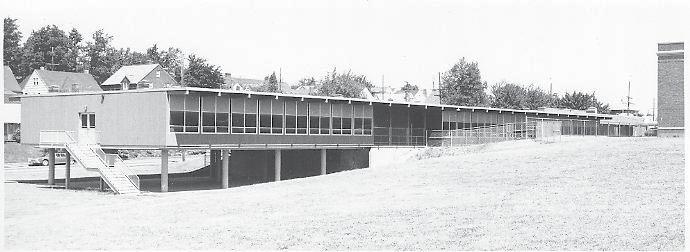
Starting with Hosford Middle School as it is called today, it is at 2303 SE 28th Pl, Portland, OR 97214
Hosford-Abernethy is a neighborhood in the inner Southeast section of Portland, Oregon, called Ladd's Addition. Being Abernethy is in this neighborhood, Hosford must be, also. Ladd's is bordered by SE Hawthorne, Division, 12th, and 20th streets. It is part of the Hosford-Abernethy neighborhood association.
An article we found written by Jesse Leonard in 1964 explains Hosford's interesting past.
It is important to note that Hosford Middle School sits on ancestral lands belonging to


Hosford Middle School has an interesting and rich history.
Rev. Chancey O. Hosford (1820-1911) was born in New York state and came to Oregon in 1845. He studied theology at "Oregon Institute" before it was renamed Williamette University, and was a Methodist minister at Vancouver, Washington in the 1850's and at Mt. tabor beginning about 1861. He was also a school teacher. While living and studying at Salem, he had acquired a land claim, and he traded that for 200 acres on Mt. Tabor. From: Portland Names and Neighborhoods by Eugene E. Snyder.


Abernethy has been a gathering and learning place in inner SE Portland for 99 years. Abernethy was built in its present location at SE 14th Avenue and Orange Street in 1925. The school was named "Abernethy" after the first provisional governor of Oregon George Abernethy. At Abernethy, we believe that a strong neighborhood school creates a safer and friendlier community for everybody.
The families, teachers and staff at Abernethy are proud to continue the tradition of being a part of a strong, viable neighborhood school.
Although the school is closely identified with the Ladd's Addition neighborhood, Abernethy actually serves a much broader community. Abernethy's official boundaries span from SE Powell to SE Hawthorne Blvd., and from the Willamette River up to approximately SE 39th Avenue.
Abernethy is proud of its history. Several families at Abernethy have had two or more generations attend the school. We believe that our rich history gives the school a strong foundation on which to build a promising future.
I attended school here and my classes included Kindergarten to graduate the 8th grade. I skipped twice, 6B and 7B being the year was divided into 2 semesters, so I skipped a whole year total.
I was told that Ladd's addition used to be the farm of a Mr. Ladd. William Sargent Ladd (1826-1893) was the farmer who owned the land that became Ladd's Addition in Portland, Oregon.
- Ladd was a prominent businessman, politician, and philanthropist in Portland in the 1850s. He was born in Vermont and moved to Portland during the California Gold Rush. The California gold rush (1848–1855) began on January 24, 1848, when gold was found by James W. Marshall at Sutter's Mill in Coloma, California. The news of gold brought approximately 300,000 people to California from the rest of the United States and abroad.
- He was elected mayor of Portland twice in the 1850s. He co-founded the first bank in Oregon in 1859. He built the first brick building in Portland.
-
How did Ladd's Addition come to be? In 1891, Ladd subdivided his 126-acre farm for residential use. The development was inspired by Pierre L'Enfant's plan for Washington, D.C. The neighborhood was designed with a radial street pattern, a central park, and four diamond-shaped rose gardens. Ladd's Addition is considered one of the oldest planned communities in Oregon. - Past meets present… William Sargent Ladd became one of Portland's wealthiest men in the 1850s. He was elected mayor in 1854, but it was not until 1891 that he decided to subdivide his 126-acre farm on Portland's eastside. Primarily developed in the 25-year span between 1905 and 1930, the real estate development known as Ladd’s Addition resulted in an architecturally rich mix of compatible early 20th century styles, including bungalow, craftsman, American foursquare, mission, Tudor, and colonial revival. Possibly the most remarkable characteristic of this community is its continuity of scale, setback, orientation, and materials.
One of our famous rose gardens in Ladd's Addition


No comments:
Post a Comment